PRC Data Challenge 2026 · Machine learning
Predicting
taxi-out time.
Exploring flight data, testing CatBoost features and reproducing experiments in a team prediction pipeline for ten European airports.
- My focus
- Exploration & experiments
- Tools
- Python · CatBoost · Parquet
- Validation
- Held-out Jan + Jul 2025
- Project type
- Data modelling · Non-game
The problem
Estimate how long a departure spends on the ground.
The challenge is to predict taxi-out duration: the time between leaving the stand and takeoff. Airport, traffic and data-quality differences make it important to test features across more than one time period.
My contribution
Explore, compare and reproduce.
- Inspected Parquet datasets, columns, missing values, airport information and anomalies.
- Ran and tested CatBoost models, including V2 with 15-minute traffic features.
- Tested additional features through V6 ablation experiments, including
WK_TBL_CAT_flt. - Reproduced Exp04 and checked that the results matched the reference experiment.
- Investigated weather-related features and F3 modelling approaches, and compared root mean squared error (RMSE) in experiment logs.
Constraint & testing
An improvement needs to survive another month.
The documented team pipeline validates on January and July 2025, keeping the scored month out of model fitting. The corrector is tested by training on one month and scoring the other, then pooling the squared errors.
My contribution was exploratory modelling, evaluation and reproduction. The final pipeline and its reported scores are team results.
The team result.
Lower RMSE is better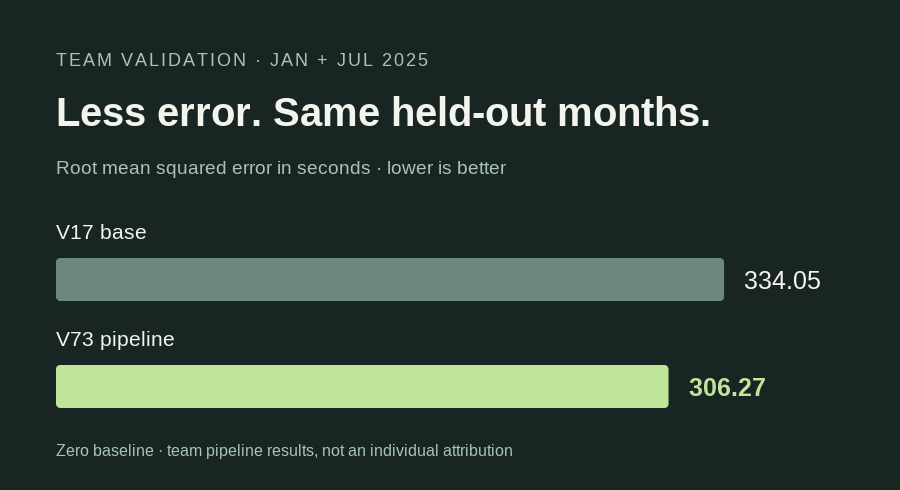
January + July 2025, team pipeline. The separate competition leaderboard score is a different evaluation and is not plotted here.
What failed & changed
Keep the experiments that hold up.
The public pipeline notes record that weather features were tested but not retained. An ADS-B-first direct-model blend failed the July validation criterion, and other candidate blends were rejected for no gain or inconsistent performance.
The documented final pipeline uses an ADS-B corrector, context and gate-retention features, and targeted post-processing. This is the team’s recorded iteration history; it is not a claim that I personally implemented every stage.
Outcome & evidence
Results you can inspect.
The team’s documented pooled validation RMSE fell from 334.05 to 306.27 seconds. My work strengthened familiarity with feature ablation, comparing experiment logs and reproducing an existing result.
This is a data project, so there is no playable demo. The repository contains the pipeline documentation and reproduction commands.